

Eassons Transport automated load entry with Pallet achieving 98% touchless processing


“Pallet is automating our button-pushing, so our team can focus on high-touch account management and sales.”
Customer
Eassons Transport Group
Headquarters
Nova Scotia, Canada
Operation Type
Asset-based Carrier
Services Offered
LTL, FTL, Brokerage, Cold Chain, Cross Border
Summary
Eassons Transport Group deployed Pallet to automate load entry for temperature-controlled shipments across Canada. Tenders that previously required manual reading and TMS data entry now flow through an AI agent that extracts load data, enriches it via API, and posts directly into Trimble TruckMate. The result: customer service staff redirected from repetitive data entry, and faster load processing across 10,000+ monthly loads.
About the company
Eassons Transport is a family-owned, asset-based carrier headquartered in Kentville, Nova Scotia, operating a fleet of over 300 trucks across Canada. The company specializes in temperature-controlled full truckload and LTL shipments, moving millions of pounds of perishable goods every week.
Cody Arsenualt, Director of IT, leads technology at Eassons. Will Easson, VP Continuous Improvement, oversees all improvement projects plus strategic plan items and represents the next generation of family leadership.
Challenge
Eassons needed to maintain its load processing capacity as experienced team members retired, and a Canadian labor shortage made backfilling those roles difficult.
Before Pallet, when a customer tendered a shipment, a customer service agent had to open the email, read the load tender PDF, and manually enter the shipment details into TruckMate, the company's TMS. A team of 10 people managed inbound load requests throughout the day, processing everything from route details and stop sequences to temperature requirements, weights, and pallet counts. Each ticket costs around $4 of manual labor to enter.
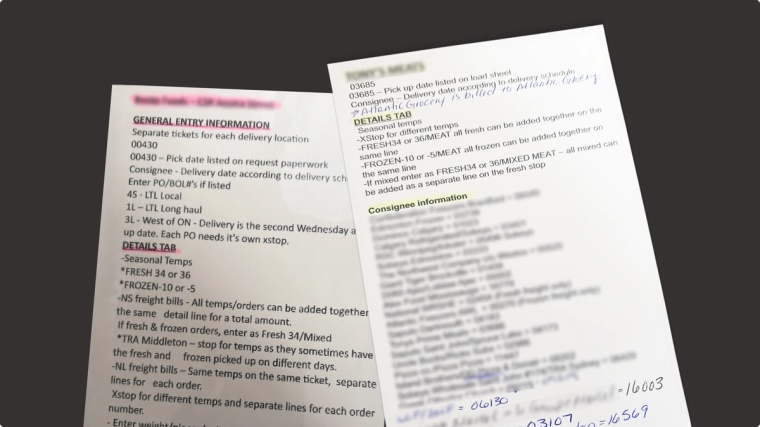
Each customer sent load tenders in different formats from structured PDFs to plain emails that simply said "I want you to pick something up tomorrow." Entering a single load required multiple steps and judgment from experienced operators:
- Incoming loads were reconciled against TruckMate to ensure that there were no duplicates
- Long-hauls with multiple stops were split into parent-child loads with multiple BOLs
- Weight calculations had customer-level exceptions. For example, most customers refer to a “unit” as a case, certain customers refer to a unit as a pallet which contains 24 cases.
- Delivery schedules varied based on the city and customer. Temperature requirements vary by season, location, and weather.
Eassons had taken several swings at automating order entry before: customer-facing portals, Excel templates for customers to fill out. None of it worked.
Customers don't want to pay to have to do their own work. Our own attempts at automation were missing the key element of AI being able to learn how customers wanted to work with us.
Cody Arsenualt
Director of IT
Solution
Eassons needed a system that could parse unstructured documents and communications, apply the business logic and institutional knowledge of their operators, execute downstream workflows, and integrate directly with Trimble TruckMate. Pallet delivered on all of it.
Pallet deployed an AI agent that reads inbound load tenders, extracts the relevant shipment data, and performs the same enrichment steps a human would: querying TruckMate to retrieve consignee IDs, pulling delivery schedules based on route and customer, and posting a completed load directly into the TMS.
The Pallet team worked on-site in Nova Scotia alongside Eassons' customer service team, capturing tribal knowledge iteratively and learning the exceptions and edge cases that only surface through real-world use. Six weeks later, the agent was ready for production. The depth of that tribal knowledge surprised even Eassons. Their lead account manager had built a physical recipe card holder, one card per customer, documenting the unwritten rules for each account: which temperatures to set, which weight conversions to apply, which delivery schedules to follow. None of it was encoded in any system.
The initial deployment focused on one of Eassons' largest customers, representing roughly 300,000 pounds of fresh chicken per week. That was a deliberate choice. Temperature-controlled shipments with multi-stop sequences represented some of the most complex operations at Eassons.
Impact
Eassons achieved 98% touchless load processing, matching the performance of their most experienced customer service agents. Loads that previously required manual reading, cross-referencing, and data entry now process automatically. New edge cases were automatically escalated to human operators.
Once the initial customer was live, scaling was fast. Each additional customer could be onboarded within 48 hours.
We sent over a couple examples late Wednesday. We had a call Friday afternoon and the customer was ready to go live.
Cody Arsenualt
Director of IT
For Eassons' leadership, AI wasn't about reducing headcount. The team was constantly under strain and hiring was difficult. Automated load building gave each team member bandwidth for higher-value work, including high-touch customer service and sales, while giving leadership more flexibility to plan around retirements and departures.
As Will Easson framed it, the shift was about freeing the team from transposing data so they could focus on building customer relationships and finding sales opportunities. Eassons is expanding its use of Pallet beyond load entry, deploying additional agents to automate workflows across load execution.


