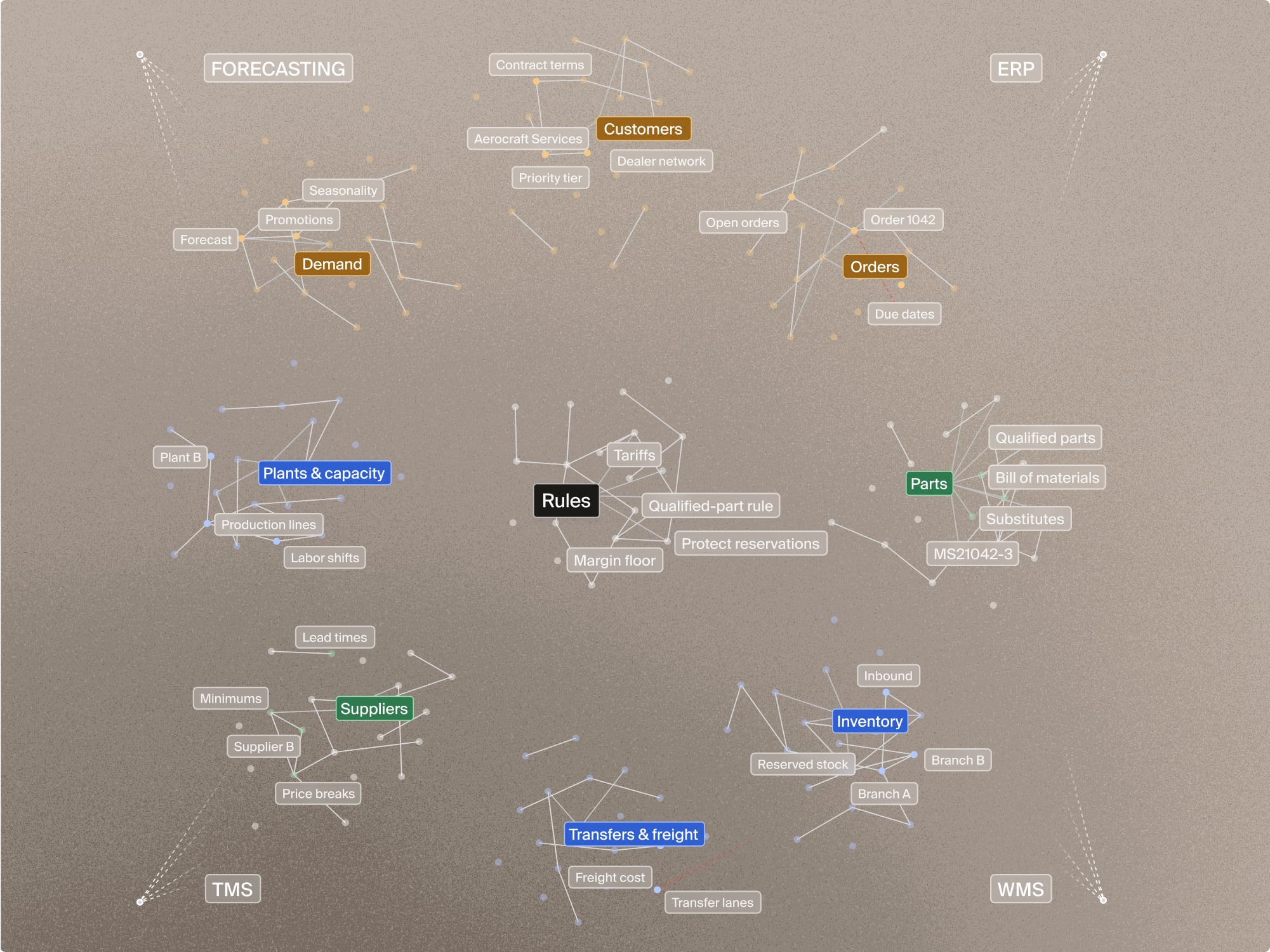
Atlas brings disconnected data together, so planners spend less time chasing updates and more time evaluating options.
Before / Disconnected data
Chase updates across systems and spreadsheets, then check business rules before you can make a decision.
After / Connected in Atlas
Compare options using connected data and business rules, so you can see the tradeoffs before you act.
Intelligence
Compare options
with the full picture
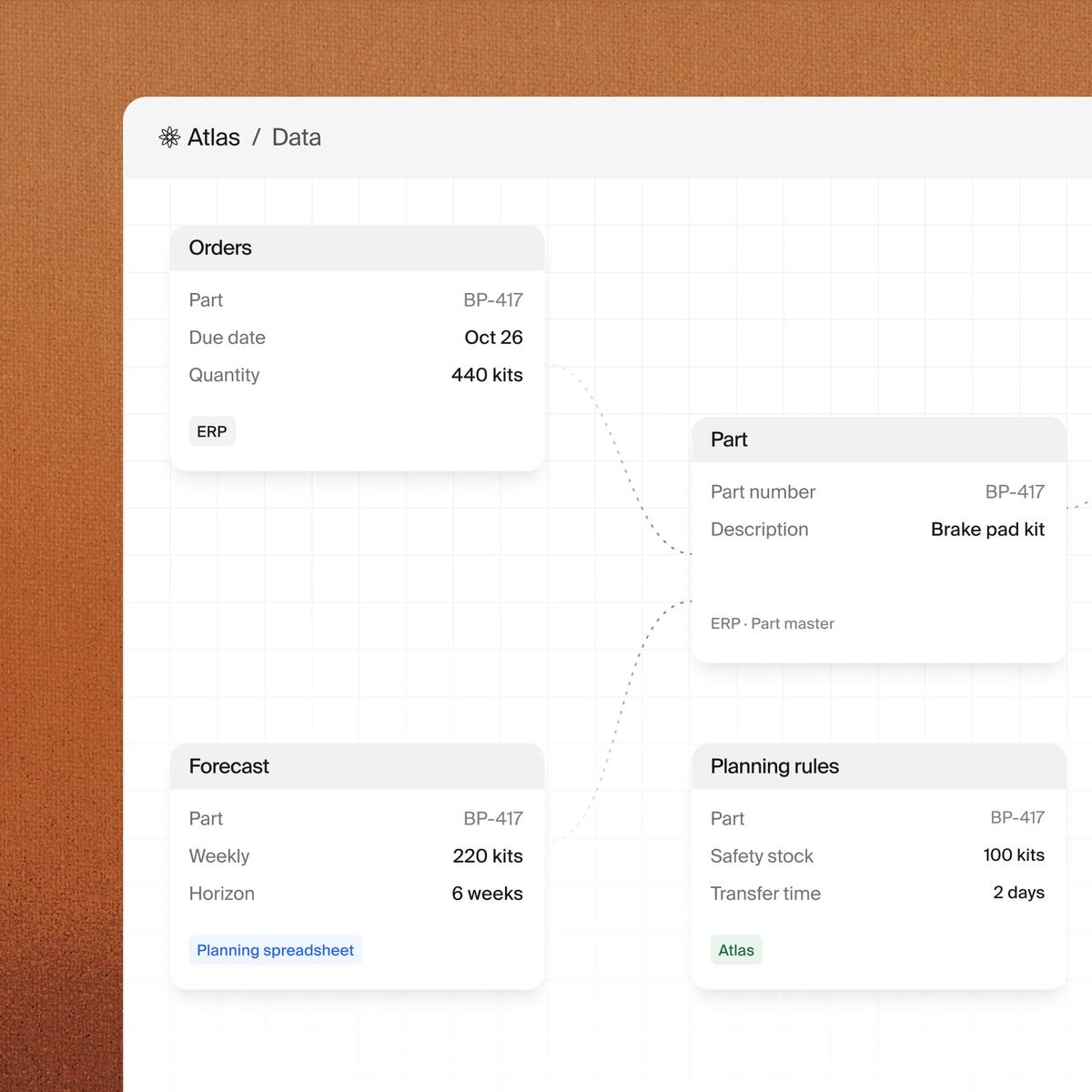
Work from connected orders, inventory and capacity across your existing systems, with forecasts and planning logic in the same model.
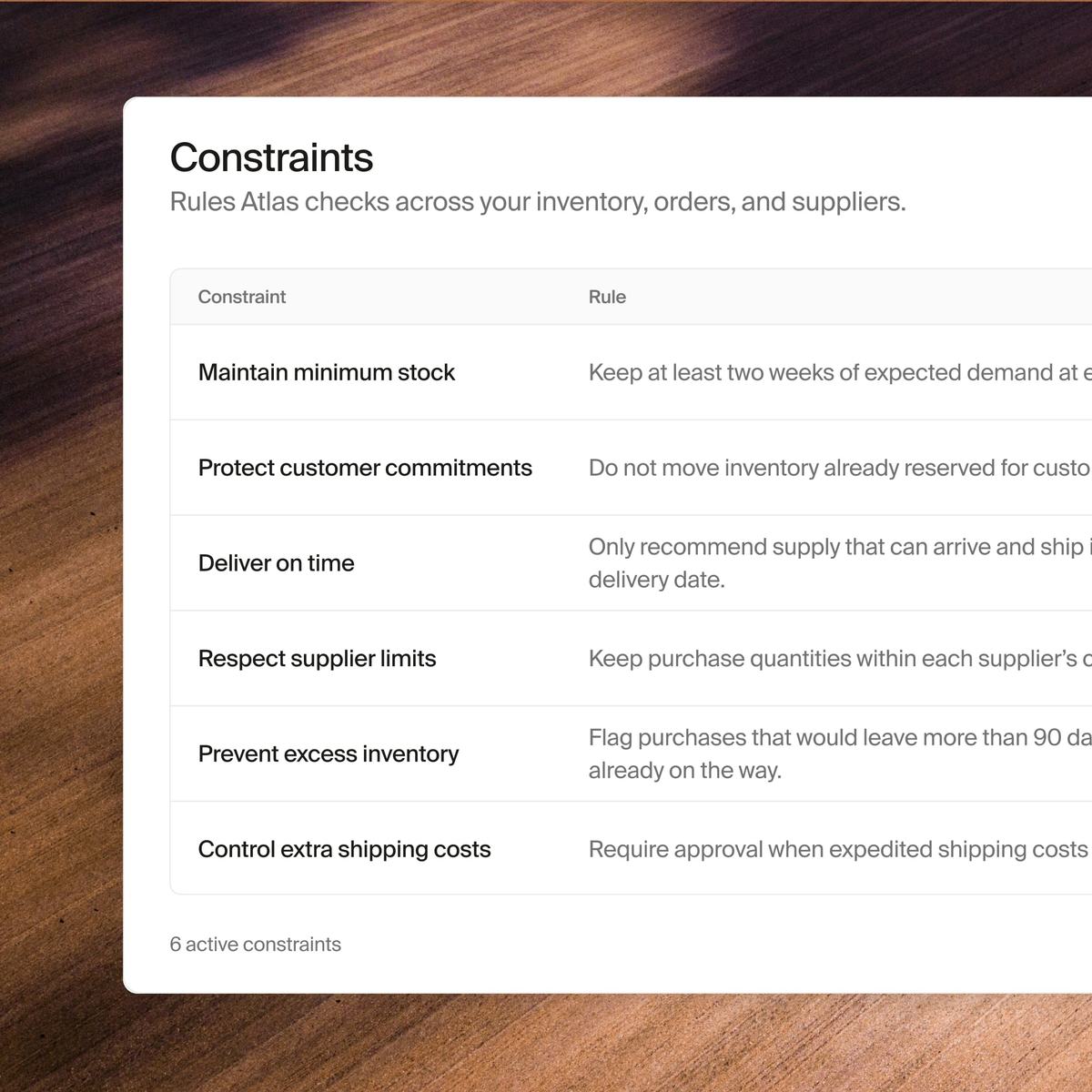
Account for customer-qualified parts, reserved stock, supplier terms and eligible production lines when comparing options.
Compare delivery dates, cost and the impact on other orders. Trace recommendations to source records and assumptions.
Meet demand at the right cost
Demand alignment
Keep purchasing and production aligned with forecasts, orders and changing customer schedules.
Supply planning
Match demand with on-hand and inbound supply. Compare replenishment and expediting options to protect delivery commitments.
Order allocation
Allocate limited inventory across competing orders. Weigh customer priorities, delivery commitments and margin while protecting existing reservations.
Procurement planning
Choose what to buy, when and from whom using lead times, minimums, price breaks and tariff-adjusted landed cost.
Production allocation and order promising
Match orders to eligible plants, lines and production weeks using capacity, labor and existing commitments.
Inventory rebalancing
Position stock across branches using local demand, available inventory, freight cost and transfer lead times.
Decision intelligence in practice
AEROSPACE PARTS DISTRIBUTOR
Cover demand without using reserved stock
When customer schedules change, Atlas compares buying, transferring, or expediting qualified parts so planners can meet demand without disrupting other orders.
EQUIPMENT MANUFACTURER
Find capacity before promising a date
Atlas checks labor, capacity, and booked orders across plants so planners can choose a production slot and commit to a delivery date.
Turn decisions into action
Approve a recommendation and let Pallet agents handle system updates, supplier follow-ups and warehouse coordination.
We operate under GDPR, the world's strictest standard for data privacy.
SOC 2 · Type II
Independently audited controls for security, availability, and confidentiality across our systems.
CCPA
Full compliance with the California Consumer Privacy Act for the data we process on your behalf.
Frequently asked questions
Atlas is Pallet’s decision intelligence product for supply chain operations. It connects operational data and business rules so teams can compare options, understand tradeoffs, and choose their next action.
Supply chain decision intelligence connects operational data, business rules, and possible actions to help teams decide what to do next. Atlas helps teams compare options, understand their consequences, and pass approved actions to Pallet agents.
Business intelligence helps teams analyze data and understand performance. Decision intelligence focuses on evaluating possible actions and their consequences. Atlas connects operational data and business rules so teams can compare options and understand tradeoffs.
Atlas is designed for supply chain, operations, and data teams at manufacturers, distributors, retailers, and logistics providers. It helps teams make decisions that depend on information spread across multiple systems.
Atlas supports decisions about purchasing, inventory allocation, replenishment, production capacity, and transfers between locations. Teams can evaluate questions such as whether to buy, transfer, or expedite supply, and where to produce an order to meet its delivery date.
AI can help planners connect fragmented data and evaluate options against business constraints. Atlas brings orders, inventory, capacity, forecasts, and planning logic into the same model to support purchasing, allocation, production, and replenishment decisions.
Atlas helps planners compare how to allocate limited inventory across competing orders. It considers customer priorities, delivery commitments, margin, and existing reservations, alongside options to buy, transfer, or expedite additional supply.
Atlas applies your business rules when comparing plans. These can include customer-qualified parts, reserved inventory, supplier lead times, purchasing minimums, and eligible production lines, helping planners evaluate options that fit their operation.
Atlas lets planners compare delivery dates, costs, and the impact on other orders. Recommendations can be traced to source records and assumptions, giving teams the context behind each option before they commit.
Atlas helps planners evaluate a plan, and Pallet agents can carry out approved next steps. These include updating operational systems, following up with suppliers, and coordinating warehouse activity.
Atlas brings forecasts and planning logic together with orders, inventory, capacity, and business rules. Teams can evaluate purchasing, allocation, and production decisions using context from across their existing systems.
Atlas connects data from your existing operational systems so planners can evaluate orders, inventory, and capacity together. Your ERP and warehouse systems remain part of the workflow, while Atlas brings their information into a connected planning model.
The data depends on the decision you want to support. Common inputs include orders, inventory, demand forecasts, supplier lead times, production capacity, and customer commitments, along with the business rules that govern your operation.
Implementation timing depends on the systems to connect, data access, and the complexity of your business rules. The initial scope centers on a specific decision workflow and the information needed to support it.
Atlas uses dataset and record-level permissions to keep access aligned with your existing data controls. Pallet’s security controls are independently audited under SOC 2 Type II.
Teams can measure time spent assembling data and evaluating options, alongside operational outcomes such as on-time delivery, inventory levels, expedite costs, and capacity utilization. The right measures depend on the decisions Atlas supports.