Customer rules live across inboxes and systems
Formats, product codes, delivery instructions, and account preferences all shape how an order gets handled.
Agents / customer service
Automate order intake, quotes, changes, returns, and customer communications. Answer availability, order status, and delivery questions promptly and accurately across your existing channels.
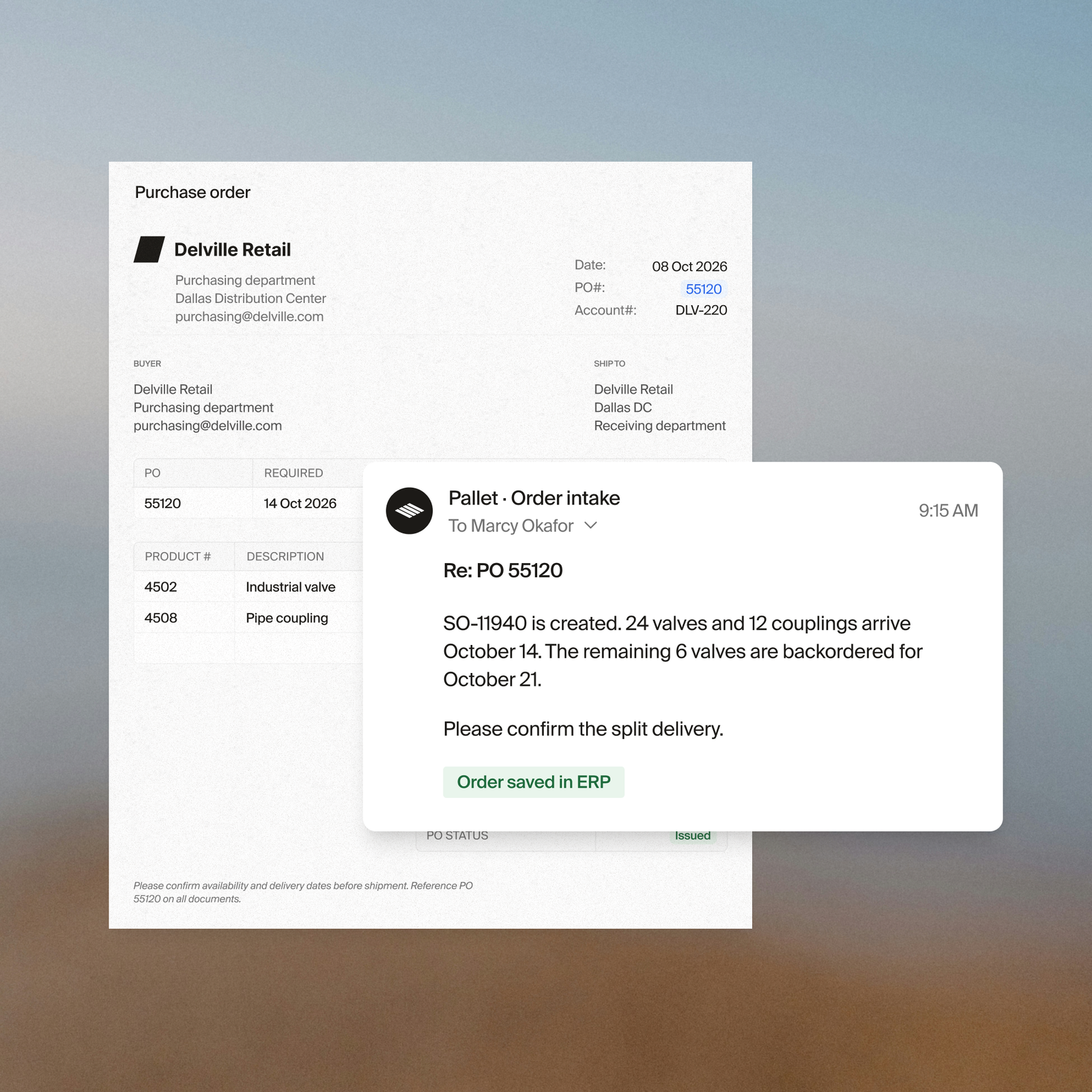
Read customer POs and shipment requests, match product and account references, and create validated records in your systems.
Collect missing details and prepare quotes using approved products, prices, rates, and terms.
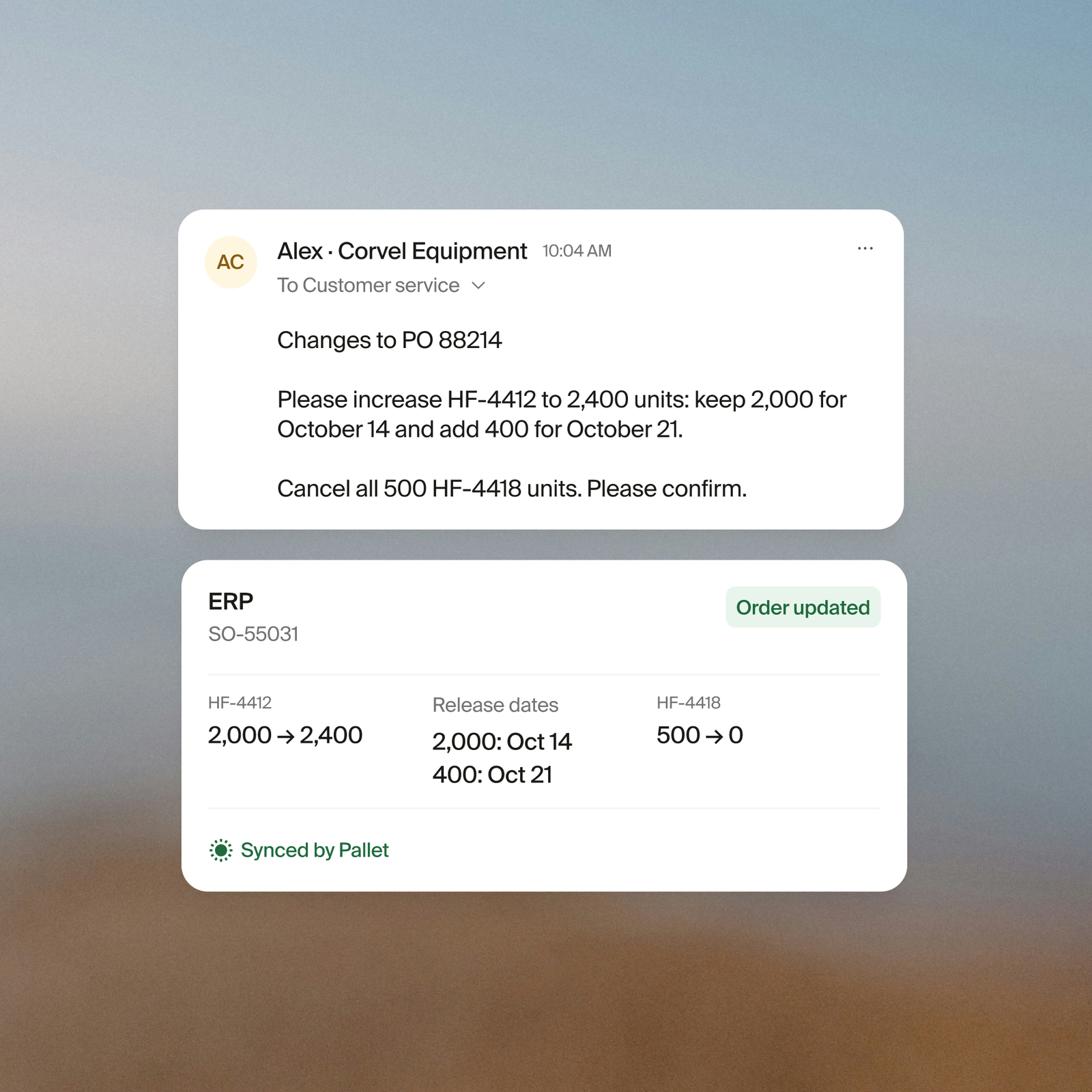
Process approved amendments, substitutions, reschedules, and cancellations. Update records and confirm changes with customers.
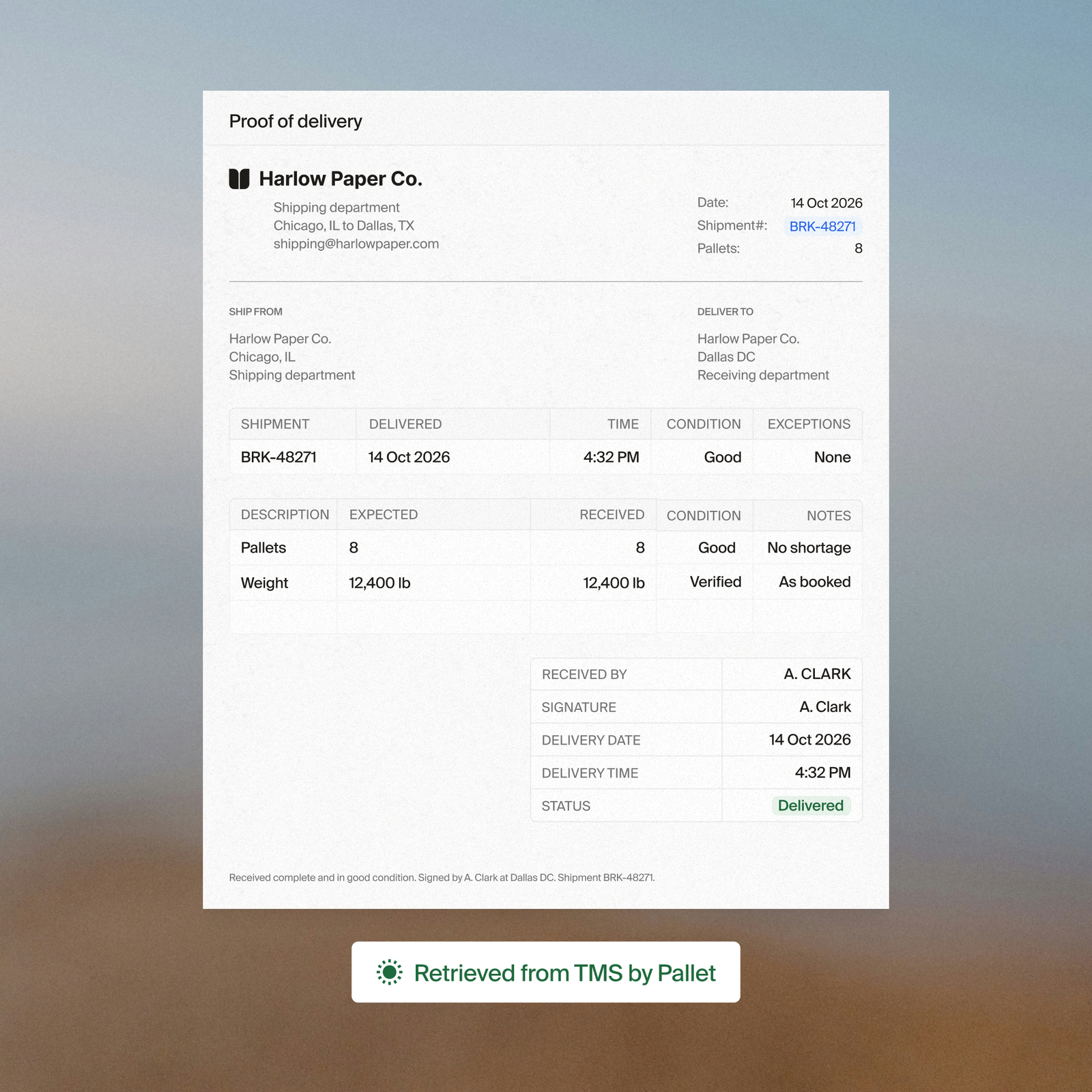
Answer availability, order status, ETA, and delivery questions using current records, PODs, and supporting documents.
Send confirmations and notify customers of shortages, delays, and exceptions using each account’s communication rules.
Use cases

Order entry
Quoting
Backorders and changes
Customer inquiries
Returns
Order entry
Quoting
Order changes
Customer inquiries
Proactive updates
Shipment entry
Quoting
Shipment changes
Customer updates
Document requests
Time to value

Formats, product codes, delivery instructions, and account preferences all shape how an order gets handled.

Pallet works alongside your operators to capture the rules, generate the agent, and test the workflow before deployment.
Institutional knowledge
Use the right product mappings, delivery requirements, contacts, and escalation paths for each customer.
Capture SOPs and operator resolutions in Memory so the next request starts with the context your team has already established.
Accuracy

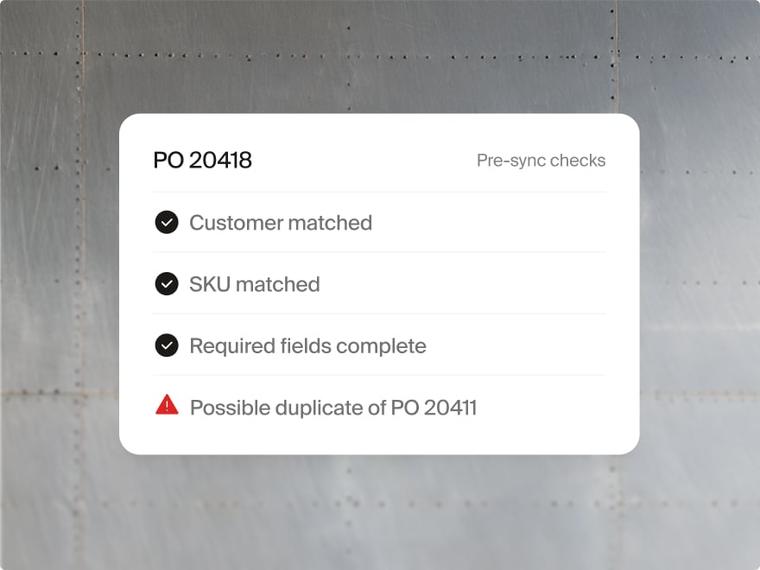
Check product and customer matches, required fields, and duplicate orders before updating your system.
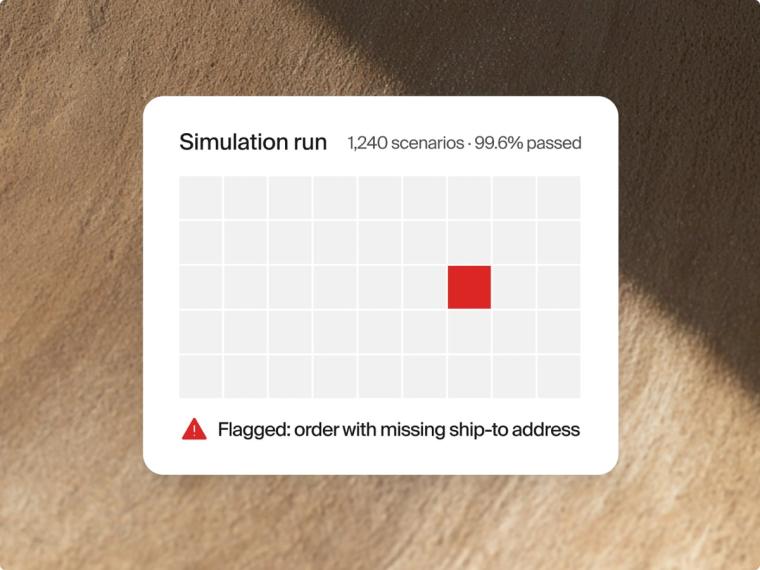
Simulate the formats and account-specific edge cases your operators encounter before the agent goes live.
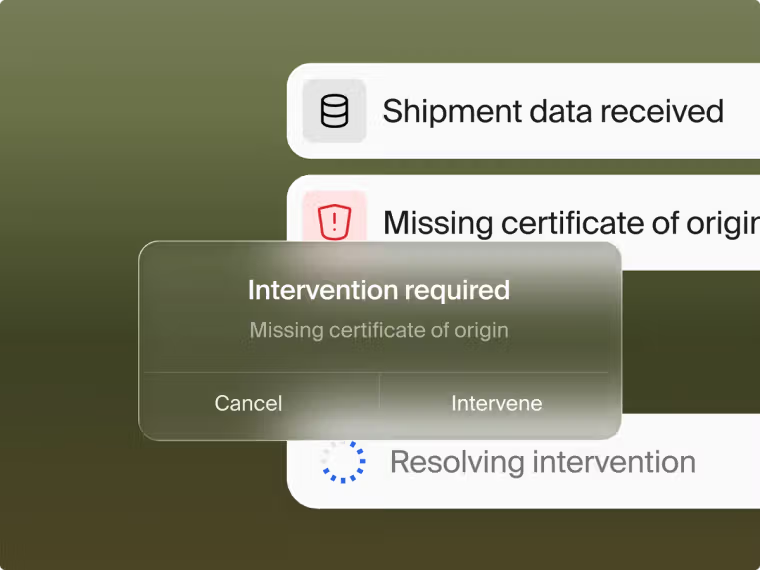
Route ambiguous requests and approval-sensitive actions to the right person with the relevant context.
Capabilities
Outlook, Gmail, Front, etc
Inbound and outbound phone
PDF, spreadsheets, scanned images
REST APIs, EDI 204/210/etc
Automate any web app or portal
Reach desktop apps with no APIs
Built for enterprise
Data handling aligned with GDPR requirements.
Audited controls, with the report available in our Trust Center.
Privacy practices aligned with California requirements.
AI customer service agents process the requests behind customer orders, quotes, changes, returns, and delivery inquiries. Pallet agents read customer messages and documents, apply account instructions, and update records in your existing systems. They support customer service workflows for manufacturers, distributors, and logistics providers.
Pallet agents read purchase orders, emails, attachments, and shipment requests, then match customer and product references to your records. They check required fields and duplicate orders before entering validated information into your ERP or shipment system. Ambiguous matches and approval-sensitive actions go to your team for review.
Pallet agents collect missing request details and prepare customer quotes using approved product catalogues, price lists, contract terms, or shipment rates. They match requested products or services to your records and follow each account's instructions. Quote preparation can include review and approval before a response is sent.
Pallet agents use order and shipment records to answer questions about availability, status, delivery dates, and delays. For logistics providers, they can retrieve proof-of-delivery documents and other shipment records. Agents can also send confirmations and proactive updates using the communication rules defined for each customer.
Pallet agents can process approved quantity changes, substitutions, cancellations, and reschedules, then update records and confirm the revised details. For returns, they capture the request, check eligibility against your rules, and issue approved return authorizations. Requests that need a purchasing, commercial, or service decision can be routed for review.
Manufacturers use Pallet for purchase order intake, release schedules, quotes, and order updates. Distributors use it for product matching, stock inquiries, backorders, and returns. Logistics providers use it for shipment entry, quoting, shipment changes, status updates, and document requests. The workflow uses the rules and records relevant to each business.
Pallet agents work through APIs, electronic data interchange, browsers, and remote desktop, alongside email, voice, and documents. This lets a workflow use the interfaces available in your enterprise resource planning, warehouse management, or transportation management systems. The connection method and required actions are defined for the workflow being deployed.
Pallet captures product mappings, delivery requirements, account preferences, contacts, and escalation paths with your operators. Agents use those instructions when handling customer requests. Workflows can include draft review and approval, while ambiguous requests are routed to a person with the relevant records and context.
Most custom Pallet agents go live in about six weeks. Pallet works with your operators to capture the customer service process, account rules, and exception paths, then builds and tests the agent before production. The deployment is scoped around the workflow and systems your team uses.
Pallet encrypts data at rest and in transit and controls access by role. Customer service workflows can retain review and approval steps for sensitive actions. Security reports and documentation are available in Pallet's Trust Center, with an overview of controls on the security page.
Keep exploring