

Introducing Pallet Signals: Making Supply Chains More Responsive
 Sushanth Raman, CEO and founder

A spike in diesel prices, a critical component shortage, or a severe weather event can change supply chain plans overnight. Responding quickly can mean maintaining better margins, keeping a production line running, or staying on schedule. The challenge is understanding the impact of disruptions to your operations and coordinating the right response before costs add up.
Pallet Signals helps enterprises catch disruptions early and coordinate a response before they become costly, without hours of manual monitoring, investigation, and follow-up.
Respond to disruptions without waiting for your team to investigate
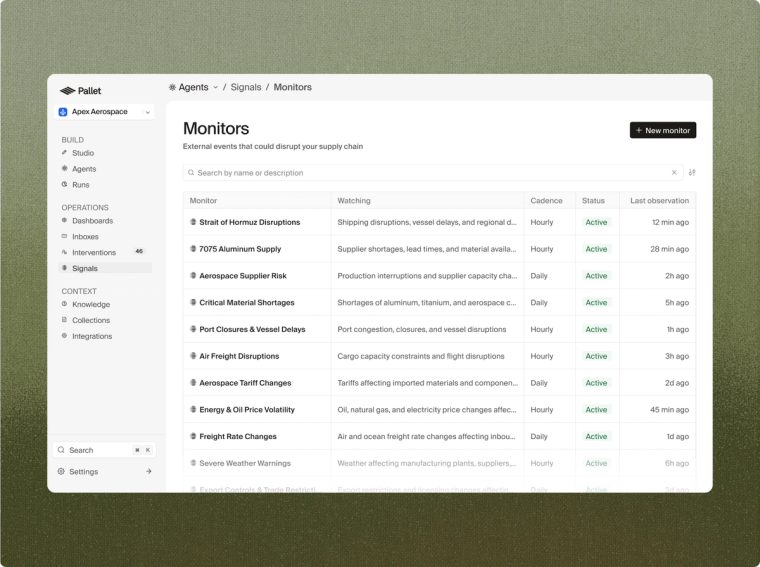
Today, supply chain teams work across disconnected data, planning tools, and automated workflows. When a product recall or severe weather event occurs, teams still have to determine what it affects, decide what needs to change, and coordinate a response across systems and partners. That work limits how quickly they can respond and how many disruptions they can manage at once.
Signals brings monitoring, planning, and execution together by combining external events with your company’s operational knowledge and systems. It identifies what matters to your business and puts agents to work coordinating the response, enabling a more autonomous supply chain.
Signals is available in both Atlas and Agents. It monitors public sources and your internal data, including supplier communications and operational systems. Signals can reason about how changes affect your operations and trigger agents to coordinate a response.
How Signals responds to supply chain disruptions
1. Keep deliveries moving when disruptions hit
When a storm or closure threatens scheduled deliveries, Signals identifies the affected loads. Pallet Agents request updated arrival times from carriers, coordinate new receiving appointments, and notify customers of confirmed schedule changes, reducing the calls and emails needed to manage each delay.
One port delay or storm on a key lane can ripple across our entire network. Pallet Signals shows us those ripples days before they reach a customer, so by the time we call, we've already rerouted and rescheduled. With Pallet, our conversations with customers are proactive instead of apologetic.
David Radom
CEO of Prism Logistix
2. Catch supplier delays before inventory runs short
When a supplier pushes back a delivery, Signals checks available inventory and open orders to identify where shortages could affect customer commitments. Pallet Agents confirm revised ship dates, ask approved suppliers about replacement stock, and prepare updates for affected customers.
3. Locate recalled products and coordinate their removal
When a recall is announced, Signals matches the notice against product and lot records to locate affected inventory and identify customers who received it. Pallet Agents coordinate warehouse holds, send recall notifications, and track responses, so teams can see where action is still outstanding.
4. Keep fuel surcharge updates on schedule
When a new diesel benchmark is published, Signals identifies customer fuel surcharges due for an update under their agreed schedules. Pallet Agents prepare the revised rates, flag exceptions for review, and draft required customer notices before the next billing cycle.
5. Identify purchasing costs affected by tariff changes
When a tariff changes, Signals flags potentially affected products, open purchase orders, and inbound shipments. Pallet Agents gather missing shipment details, request updated duty estimates from customs partners, and assemble the cost changes for purchasing and finance to review.
AI that can understand how disruptions ripple through an operation and help companies before they escalate has the potential to change how the physical economy operates from the ground up.
Bart De Muynck
Founder of Better Supply Chains
Manage more disruptions with less manual work
A more autonomous supply chain starts with understanding what has changed and knowing how to respond. Signals combines external events with your company’s data and operational knowledge, giving agents the context to carry out the work while teams stay in control of key decisions.
See how Pallet Signals can help your business respond to disruptions before they become costly.