

Announcing AS/400 Support: Pallet Fabric Reaches the Hardest System of Record
 Sushanth Raman, CEO and founder
Pallet agents can now read from and write to AS/400 through Fabric, Pallet's MCP layer, so the lookups and updates that used to live in the green screen now run on their own.
AI can read a customer email, understand the request, and draft the reply. Then it stops.
That’s because in supply chain, the answer almost never lives in the inbox. It lives in a system of record: a TMS, a WMS, an ERP, and at most large operators, AS/400. That last one is by far the hardest to work in.
AS/400 is green-screen software: a text-only terminal with no mouse and no search. Operators move through it via memorized commands and coded field names. If an AI agent can't reach that system, a human still has to go retrieve the data. That's the wall for AI in supply chain today: it works the inbox, but humans still work the green screen.
A single operator can run the same AS/400 lookup 80 to 150 times a day, and every new hire has to learn those screens and the tribal knowledge behind them before they can answer a routine customer question.
Getting deeper access is hard. There's no modern API to call. The DB2 database underneath uses cryptic field names spread across hundreds of undocumented libraries. The system sits locked down behind a VPN or IP allowlist, gated further by object-level permissions. Most customers are also, understandably, wary of handing a third party direct access to their database. Access approval alone often takes more security review than the integration itself.
The way teams bridge that today is with legacy middleware built to sync a few fields or run one fixed, pre-defined workflow. It works until the work gets messy, and it was never built for an AI agent that has to reason across context, documents, and exceptions. AS/400 is one of the hardest systems in the enterprise to make AI-ready.
Pallet Fabric gives agents access to AS/400
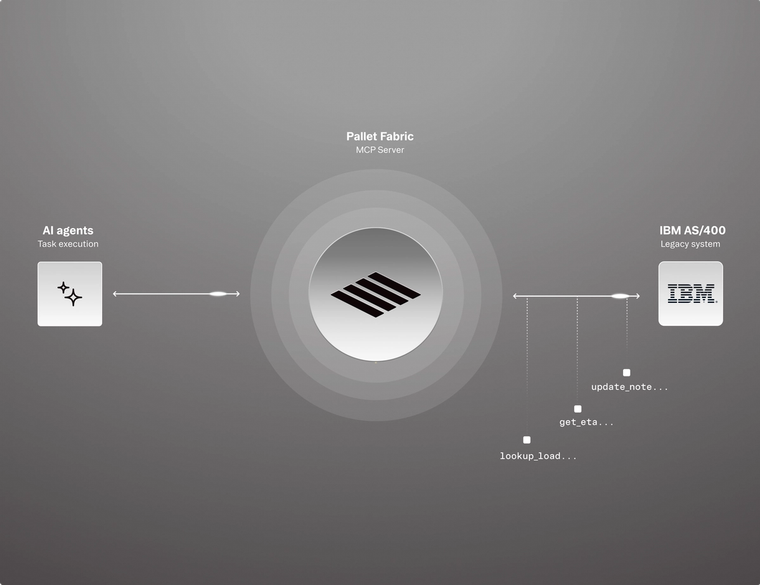
An AS/400 has no modern API, so there are only two ways in: drive the green-screen session the way a person would, or query the DB2 database underneath it directly over ODBC/JDBC. Pallet Fabric puts either path behind an MCP server. Instead of teaching an agent to navigate the green screen, that server exposes each AS/400 workflow as a clean tool with defined inputs and outputs, like lookup_load, get_eta, update_note. The agent calls the tool it needs; the MCP server handles the session, auth, and query, then returns structured data back to the agent.
It works within the access you already have, without requiring a rip-and-replace of the system underneath. Agents both read from and write to your system of record, and your team stays in control of what they're allowed to do. Operators stop keying lookups by hand, new hires never have to learn the green screen, and every update an agent makes writes back to the correct records in AS/400.
What your team can now automate with AS/400
ETA lookups and customer replies. At one national carrier, operators manually looked up loads in AS/400 to fill ETA reports, one of the biggest sources of inbox volume for the team. Agents now pull status and ETA directly, then prepare or send the update. Pallet deploys its own connector inside the carrier’s virtual private cloud, restricted to only the schemas the agents need.
Order entry. Inbound emails and documents become structured order-entry workflows an agent executes, with no manual keying.
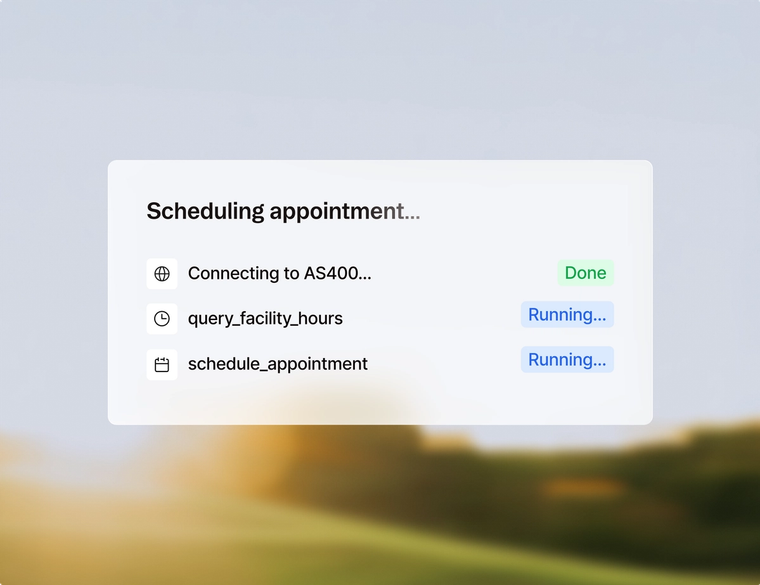
Appointment scheduling. At facilities where scheduling still happens manually in AS/400, agents book, update, and confirm appointments without the repetitive screen work.
BOL processing. In warehouse and cross-border workflows, agents read bills of lading with OCR and push them straight into the system — no manual rekeying.
The same model already extends to trailer-number updates, POD retrieval, invoice audit and auto-coding, and note and status write-back into AS/400. Once the data is exposed cleanly, it becomes the foundation for the next layer: exception flagging, proactive customer updates, and multi-step workflows that chain lookups, documents, and writes together.
One integration, every system of record
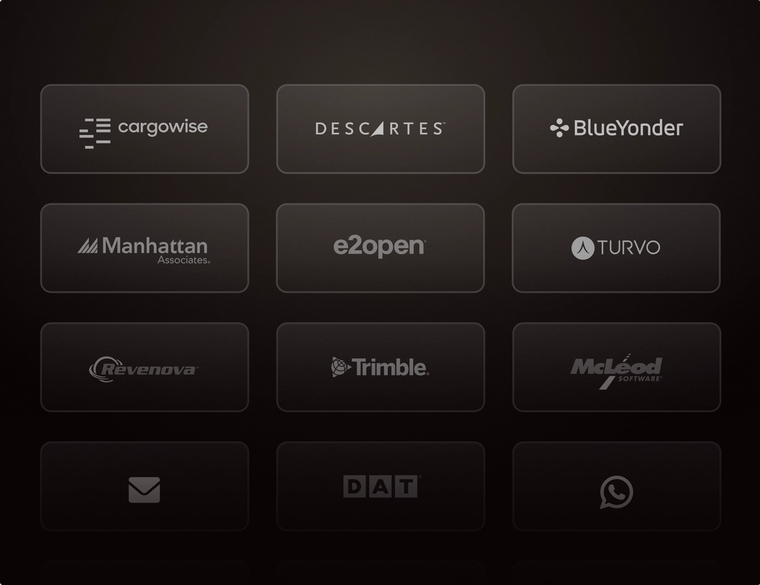
This integration runs on Pallet Fabric: the layer that connects agents to any system, however it's built. Anyone can integrate with modern SaaS and its clean APIs; Fabric is built to reach everything else: on-prem servers, homegrown internal tools, and legacy systems down to the green screen. Whatever the system, Fabric exposes its workflows as the same kind of clean tools, so an agent works a modern TMS and a decades-old terminal the same way.
AS/400 is the hardest end of that range, which is why it's the proof. If Fabric can crack AS/400, the rest of the stack is the easy part: the same model works on Manhattan, Blue Yonder, other TMS and WMS platforms, and homegrown systems. Fabric is what makes all of it AI-ready, so AI moves from reading and drafting to doing the actual work inside every system you already run on.
See the new AS/400 integration in action today.