

Introducing Atlas: Surface profitability opportunities across your supply chain network
 Sushanth Raman, CEO and founder
Your network already contains your next growth opportunity. The challenge is finding it.
Most supply chain organizations are sitting on years of operational data — lanes, contracts, facilities, customer relationships — spread across their TMS, ERP, email threads, and old RFP bids. That data holds valuable opportunities: which accounts have untapped lane adjacencies, which customers are at churn risk, where consolidation would improve margin. But surfacing those opportunities today requires days of analyst work, which means it only happens for the biggest decisions, and only when someone already suspects there's something to find.
Today we're introducing Atlas to empower everyone on your team to surface the opportunities that would improve your business.
Your data already knows the answer
Atlas is Pallet's newest product, built to surface the profitability opportunities already hidden inside your operational data.
It ingests data from your TMS, WMS, ERP, email, and documents, then normalizes and connects it, linking customers, their subsidiaries, facilities, lanes, and contracts into a unified model of how your network actually fits together. It enriches that model with external data including spot rates, lane density, and distribution center locations.
Once built, that model can be queried instantly by anyone in your organization, not just the analysts who've spent years reconstructing it in spreadsheets.
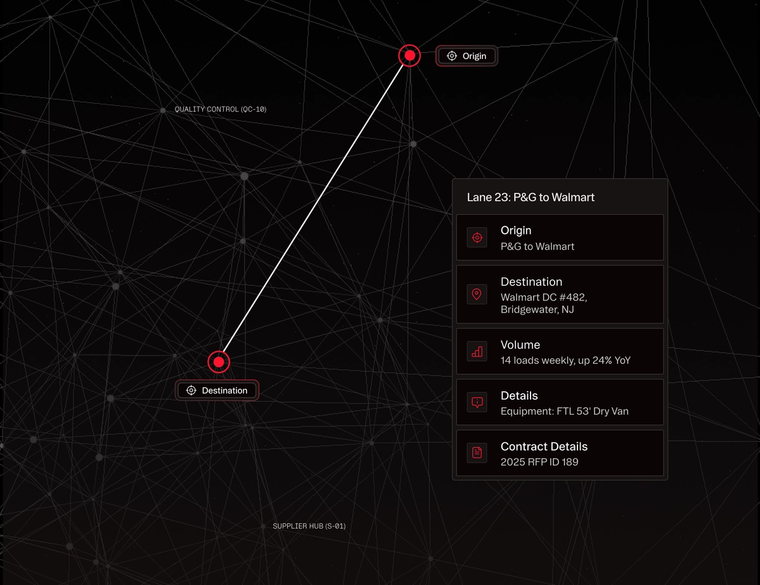
Finding growth inside your existing network
Say you're a carrier trying to grow your book of business with Walmart. A complete answer requires understanding all of Walmart's distribution facilities, which of their suppliers and distributors you already serve, what lanes you're running, and where you have operational familiarity that gives you a competitive edge. Pulling that together manually takes days.
With Atlas, you run the query. It finds Walmart's distribution facilities, maps which ones sit near manufacturers you already serve, factors in lane density and spot rates, and surfaces the specific facilities where you're most likely to win new business in seconds.
The same analysis works for triangular lane opportunities. If you're moving freight from a P&G manufacturer to Walmart, and from that same manufacturer to Meridian Distribution, you may already have relationships on both sides of a Meridian-to-Walmart lane you're not working. Atlas finds that gap. It evaluates cross-account relationships at a scale no analyst could match manually.
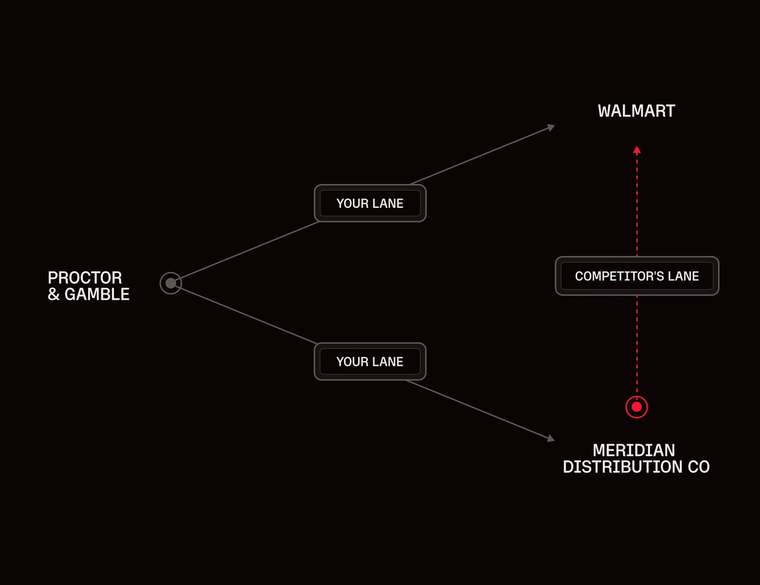
Customers are already using Atlas to uncover:
- Lane expansion: Identifying triangular and backhaul opportunities across existing accounts
- Account prioritization: Ranking customers by network complexity to understand which relationships are stickiest, and which are at risk
- Capacity planning: Predicting customer seasonality to plan ahead rather than react
- Data hygiene: Resolving duplicate or fragmented records across platforms so PepsiCo, PepsiCo Frito-Lay, and Rockstar Energy are understood as a single relationship
How Atlas works under the hood
Atlas ingests data from your operational systems, normalizes it, and links related entities. What makes Atlas powerful is that the relationships are customized to how your business runs. A 3PL may prioritize relations between facilities, lanes, and previous RFPs, while an intermodal carrier is interested in knowing the relationship between shipping vessels, containers, and drayage assets.
Atlas can even pull in 3rd party data to make the analysis more comprehensive, including lane density, spot rates, distribution center locations, and real-time weather.
Once the relationships are defined, the model is computed and made accessible throughout the organization. Record-level permissions are preserved so governance remains intact.
What previously required days of analyst work becomes an interactive query available in seconds.
Atlas improves your organization’s decision making
Strategic decisions in supply chain have always been constrained by how quickly someone can reconstruct context. Atlas removes that constraint, not just for analysts, but for operators, account managers, and leadership making decisions in real time.
When your intelligence infrastructure understands the relationships within your network, strategy is no longer limited by who understands the data best. And when AI agents operate side-by-side with Atlas, they do so against a shared context, allowing execution and strategy to operate from the same source of truth.
Atlas is live today, and you can give it a try in our demo. We can't wait to see how you use it.